Understanding Crypto Volatility and Risk
Researched and drafted with AI assistance from published sources; edited and published by NorwegianSpark SA.
Last updated: October 2026 · 5 min read
This article is for informational purposes only and does not constitute financial advice. Always consult a qualified financial adviser before making investment decisions.
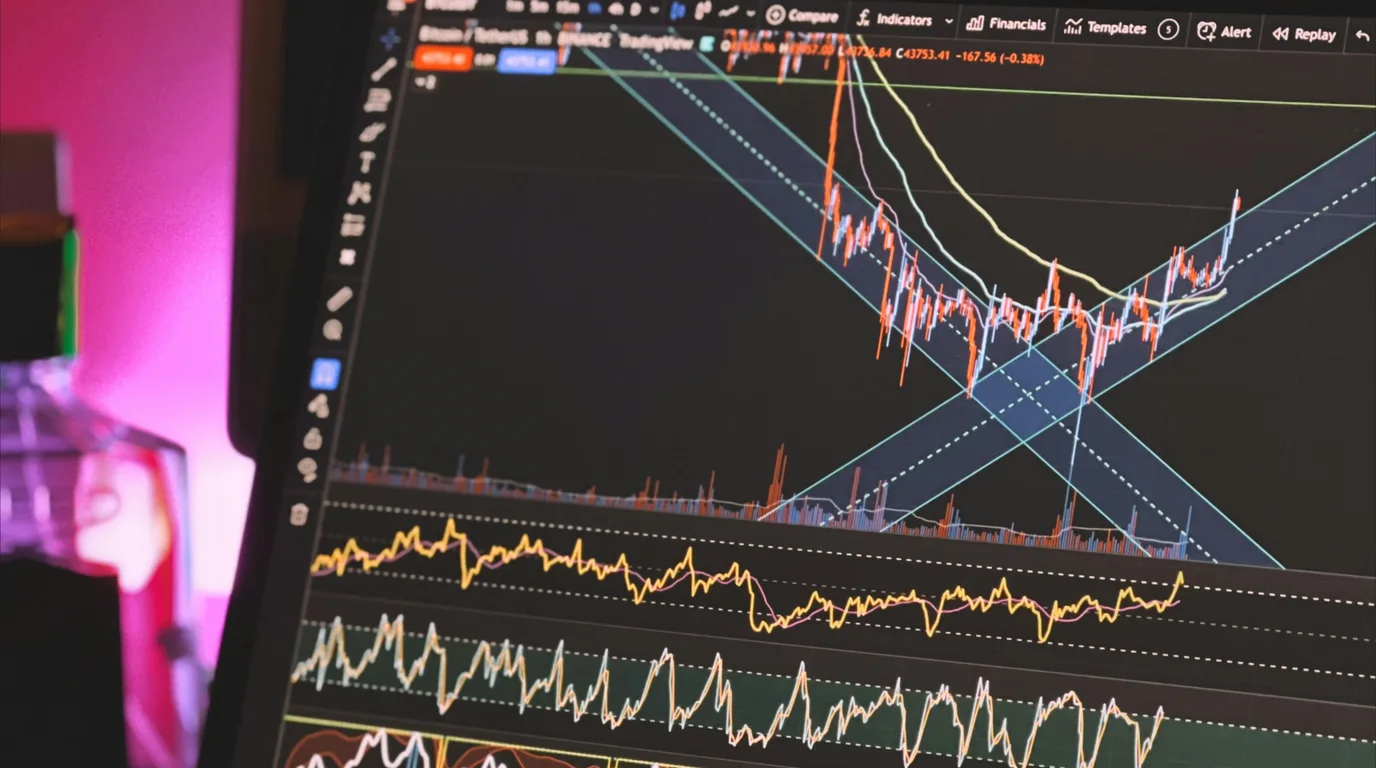
Crypto's defining feature for investors is not the technology — it is the volatility. Even Bitcoin, the largest crypto asset by market capitalisation (about 60% of the total on CoinGecko, 31 October 2026), moved 10% or more in a single day on 99 days between December 2014 and October 2026, and it has twice fallen more than 75% from a peak — about 84% in 2017–18 and about 77% in 2021–22 (Coinbase prices published by the Federal Reserve Bank of St. Louis, FRED). Understanding why, and respecting it, is what separates people who survive the space from those who get wiped out in their first cycle.
The volatility has structural causes: crypto markets are smaller and less liquid than traditional ones, trade 24/7 with no circuit breakers, are heavily driven by sentiment and leverage, and remain lightly regulated in much of the world. None of that is a moral judgement — it simply means the price can move further and faster than most newcomers emotionally prepare for.
This is why the cliché "only invest what you can afford to lose" is the single most useful rule in crypto, and it means exactly what it says: money whose total loss would not affect your rent, your debts, or your sleep. Practical risk management follows from that — modest position sizes, no borrowed money, and an honest acceptance that any individual asset can go to zero. Diversification helps but does not rescue you from a market-wide crash.
Every other guide on this site assumes this foundation. It is why we are cautious about derivatives, sceptical of trading signals, and blunt about lending risk. Tax also interacts with volatility in ways people forget — see crypto tax basics. It is also why we treat game tokens and Web3 gaming as the most speculative corner of the market, where one game's player retention sets the price.
Volatility also tends to arrive in phases rather than at random; how to read crypto market cycles explains the indicators people use to describe those phases, and their limits. For what a deep drawdown looks like while it is happening, see is Bitcoin dead? The 2026 bear market explained.
Why the Arithmetic of Drawdowns Is Worse Than It Feels
The most useful thing to internalise about volatility is that losses and gains are not
symmetrical. Recovering from a fall requires a larger rise than the fall itself:
| A fall of | Requires a rise of |
|---|---|
| 20% | 25% |
| 33% | 50% |
| 50% | 100% |
| 75% | 300% |
| 90% | 900% |
That is arithmetic rather than a market claim, and it is why avoiding the deepest
drawdowns matters far more than capturing the largest rises. It is also why position
sizing does more work than selection.
Volatility Is Not the Only Risk
Treating price movement as the whole risk picture is the common error. The others are
less visible and have historically caused more permanent loss:
what happens if a crypto exchange collapses.
disappears precisely when everyone wants it.
Price recovers. The others frequently do not, which is why "it always comes back" is a
claim about an index rather than about your position.
Sizing So That Being Wrong Is Not Ruinous
changes nothing important in your life.
here — see the emergency-fund logic in a diversified portfolio.
move are made by a different person.
buying weakness without requiring a view.
outcome into a terminal one — see
The Behavioural Half
Volatility is only partly a market problem. The reliable errors:
A written plan made in advance, with a fixed allocation and a rebalancing rule, removes
most of these — not by improving your judgement but by requiring less of it. More on
that in crypto trading psychology.
Capital at risk. Assume any position can fall very substantially and stay there.
Size every position so its total loss is survivable, and never use money you need. Whichever venue you use, Coinbase and Kraken Pro both support limit and stop-loss orders that help enforce a position size you decided in advance, not in the moment. Capital at risk; assets can go to zero. This is not financial advice.
Sources
- •FRED (fred.stlouisfed.org)
Related Articles

Nexo Review 2026: How It Works, Safety, Fees and Risks
Nexo review 2026: how the crypto lending platform works, how its tiered rates are set, security and regulation, fees, pros and cons. Crypto is high risk.
How to Earn Yield on Crypto in 2026: 5 Ways, Ranked by Risk
Five ways to earn yield on crypto in 2026 — CeFi lending, staking, liquidity provision, yield farming and crypto savings accounts — with a risk framework.
Coinbase Review 2026
Is Coinbase safe and legit in 2026? Fees, MiCA licence, Nasdaq listing and who it suits. Independent review; capital at risk.